- by foxnews
- 05 Aug 2026
Lost sermons from one of Christianity's greatest saints discovered after 1,600 years
A medieval manuscript from a German abbey contains two unknown sermons where St. Augustine weighs whether King Saul truly repented and was saved.
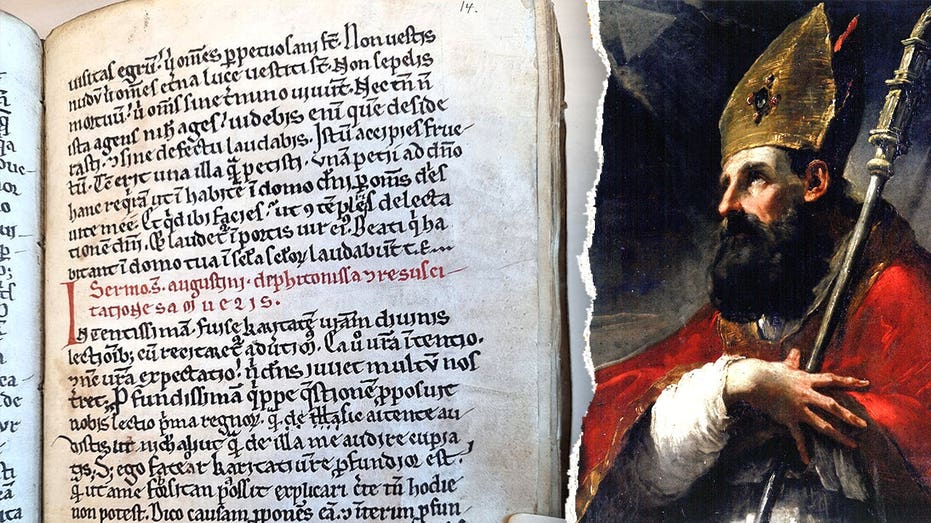
The newly discovered sermons were found on a medieval manuscript by Christian Tornau, a Latin professor at the University of Würzburg in Germany.
The manuscript was copied at Bad Doberan Abbey in present-day Germany during the 12th century, likely from an earlier manuscript that has since been lost.
St. Augustine lived from 354 to 430 A.D. He served as the bishop of Hippo Regius in present-day Algeria and was a prolific theologian.
In a press release issued by the University of Würzburg, officials said the saint "is regarded as one of Christianity's most important Church Fathers."
"His extensive body of writings continues to occupy scholars today," the university also said.
Tornau is now working to publish the sermons for the first time in a scholarly edition after nearly two years of research.
Of the manuscript's six sermons, two were previously unknown.
The two sermons explore the Old Testament story of the Witch of Endor, in which King Saul consults a witch before a battle against the Philistines.
Augustine's sermons show him weighing the possibility that King Saul repented and was ultimately redeemed after hearing Samuel's prophecy.
"The first sermon was preached during a Sunday service and ends by presenting the theodicy question and the possible interpretations," Tornau told university officials.
"Only in the second sermon, delivered the following Wednesday, are the alternatives weighed ... the style, humor, and content also strongly indicate that the sermons preserved in the manuscript really are by Augustine."
The interpretation of Saul being saved is the "most remarkable element" of the new sermons, Tornau told Fox News Digital.
"This is unparalleled in Augustine and in ancient Christianity in general, where we find a very negative image of Saul," said Tornau. "Augustine suggests it ... and clearly takes it seriously."
The professor noted that Augustine may have independently developed the idea that King Saul repented and was ultimately saved after hearing Samuel's prophecy, or he may have been influenced by Jewish rabbinic interpretations that viewed Saul more favorably.
"In any event, it is indicative of Augustine's [independence] of mind and his willingness to think everyone, even those who appear most evil, [are] capable of salvation through the grace of God," he said.
"This combines intellectual honesty and episcopal humility in a remarkable and very Augustinian way."
The texts can "confidently" be dated to Late Antiquity, Tornau added, because they reflect a style of Christian liturgy that would have been impossible in the Middle Ages.
"The background is North African, as is clear from the concluding prayer of the first sermon, which is only attested in late-antique Africa," he said.
He also noted that the sermon's author "is familiar with Augustine's thought and works but does not simply copy them, which would be a sign of inauthenticity."
"After this intense period of reading and interpreting, we came to the conclusion that there are no serious objections to Augustine's authorship," he said.
"We were fascinated, of course, by the idea of having found new sermons of Augustine, but soon turned skeptical because [in] some places the sermons did not seem to read like Augustine," Tornau said.
"Our final verdict is that they are indeed authentic."
you may also like


- by foxnews
- 05 Aug 2026
Shark Week shocker as great white breaches just yards from oblivious boogie boarder
- by foxnews
- 05 Aug 2026
Lost sermons from one of Christianity's greatest saints discovered after 1,600 years



travel
- by foxnews
- descember 09, 2016
Thousands swarm stunning mountain escape as selfie tourism backlash erupts online
Photos are showing massive shuttle lines at Tre Cime di Lavaredo in Italy as selfie tourism overwhelms one of the Dolomites' most iconic destinations for travelers.
read more