- by foxnews
- 18 Sep 2026
Jesus' crucifixion account gets fresh look after ancient ring tied to Pilate is reinterpreted
Offering new clues about Jesus' crucifixion, an ancient ring found at Herodium may reveal how Pontius Pilate delegated authority in Roman Judea. Experts shared insights.
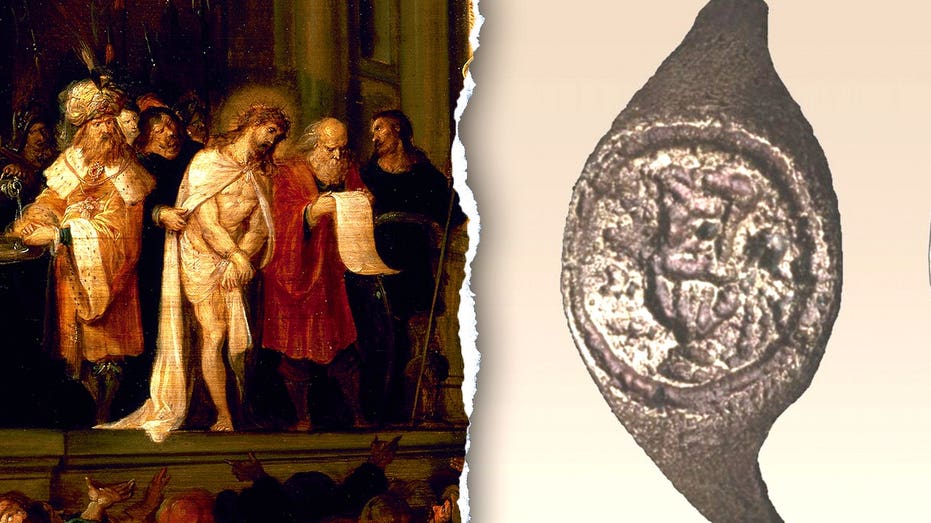
The ring, discovered at Herodium, a mountaintop fortress in the Judean desert, in the 1960s, has long been known to archaeologists, but a new interpretation could help explain its connection to Pilate.
The 2,000-year-old ring sat in storage for over 50 years before researchers published details about it in 2018, according to a release from the University of California, Los Angeles (UCLA).
Bonesho concluded that the ring's wording was a transliteration of the Latin PILATO - meaning "for Pilate" or "to Pilate" - into Greek letters.
This theory, Bonesho argued, better explains the inscription than the earlier interpretation that it was a misspelled or abbreviated Greek form meaning "belonging to Pilate."
The professor argued the ring likely did not belong to Pilate himself but may have been worn by a lower-status worker who was carrying out administrative business connected to him.
"Looking at the poor quality of the ring, the Greek transliteration, the fact that those who used seal rings, like secretaries, are more likely to have been enslaved or formerly enslaved workers - all of that gives us insight into what was happening then," she added.
Fox News Digital reached out to Bonesho for further comment.
Moss, the Edward Cadbury Professor of Theology at the University of Birmingham, said the new interpretation could help resolve a years-old puzzle: If the inscription refers to Pilate, why is the ring so cheaply made?
"This isn't an expensive ring, the kind of thing that you would expect the person who is the governor of the whole area to have," Moss said.
Moss concurred that the ring may have been used by someone working under Pilate and acting with his authority.
"When they made business decisions or legal decisions, they used his ring to kind of set a seal and show that they had the authority [of Pontius Pilate] and, by extension, of the whole Roman bureaucracy behind them," Moss said.
John's account says Pilate wrote the inscription identifying Jesus as "King of the Jews."
Moss said the ring may illustrate how an act carried out by a subordinate under Pilate's authority could nevertheless be attributed to Pilate himself.
"He delegated that work to someone else," she said.
you may also like

- by foxnews
- 18 Sep 2026
US warns Americans to stay vigilant as terror risk looms at major vacation hot spot

- by foxnews
- 18 Sep 2026
Dolly Parton could soon have major airport named in her honor after unanimous vote


travel
- by foxnews
- descember 09, 2016
Lost city where Jesus performed miracles has finally been identified, expert says
Bethsaida, the home of Apostle Peter and the setting of Jesus Christ's miracles, may finally be identified after a decade of archaeology work at El-Araj.
read more