- by foxnews
- 06 May 2026
Humanless big rig completes first US freight run
Bot Auto claims its truck made the first fully humanless commercial delivery in the U.S., traveling 230 miles from Houston to Dallas with no driver.
- by foxnews
- 06 May 2026
- in technology
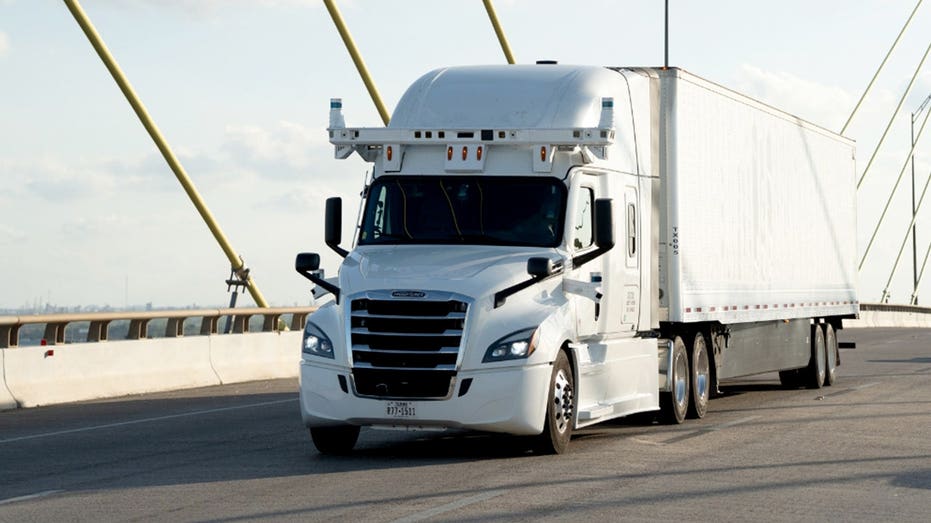
More importantly, the run followed a real customer timeline and moved through the same freight network that companies rely on every day, rather than a controlled test or staged demonstration.
Here's a breakdown of exactly what happened and why it matters.
Sign up for my FREE CyberGuy Report
That's the part that stands out. This ran like a normal overnight load, just without a driver.
The load moved through Ryan Transportation, not a special test system. Hou makes that very clear, "Real freight, real customer, real timeline, delivered safe and on time. We are not disclosing the shipper or commodity, but this was not a load we manufactured to check a box. It moved through Ryan Transportation, a top-20 freight brokerage. Booked, priced, and executed the same way as any truckload moves in America. We made money on it. This is a commercial business, not a research project." In other words, nothing about this run was staged behind the scenes.
Many companies still rely on hidden human support. Bot Auto takes a different approach.
That's a big difference from systems that still lean on human backup.
One of the biggest concerns, and understandably so, is how the autonomous driving system reacts under pressure. Hou said the truck is designed to handle that on its own.
"The truck would not wait for a human to save it," he said. "If it reached a condition outside its approved operating boundary, it would enter a mitigated risk condition: slow down, create space, and bring itself to a controlled safe state. The principle is simple: when the truck encounters extreme or unexpected situations, it does not gamble. It acts conservatively. Sometimes that means stopping; sometimes it means continuing briefly to reach a safer place to stop. Human support can help after the vehicle is already safe, but the vehicle has to own the first minute."
So the system is designed to play it safe first, then deal with the situation after it is under control.
Bot Auto says removing the driver came after extensive validation and careful testing.
That is the level of testing the company says it absolutely needed before taking the driver out completely.
Technology alone does not transform an industry. Economics do. Hou says the numbers already work.
"With that complete accounting, the economics still work decisively in our favor," he said. "This run came in below $2 per mile."
That puts the cost of this trip below what a human-driven truck would typically run.
Hou also pushed back on simplified comparisons. "I want to be precise here, because the industry has a habit of cherry-picking the easy savings and hiding the real costs... autonomous trucking's cost impact isn't a simple trade-off between driver wages and vehicle cost, it runs deep into operations." The point here is that the savings go beyond just removing the driver.
"Texas passed Senate Bill 2807 in 2025, creating a formal authorization program for commercial autonomous vehicle operations, administered by the Texas Department of Motor Vehicles," Hou said. "Bot Auto applied and was approved under that program... We met every requirement."
That includes safety compliance, system reliability and the ability to safely stop if something fails.
The bigger question now is whether this type of run can happen consistently across real freight lanes.
"The Houston-to-Dallas lane is repeatable now, and it isn't a one-time event," the company said. "We selected it deliberately: high freight volume, strong hub infrastructure at both ends, a supportive regulatory environment. Expansion is already underway."
The company is focusing first on high-volume freight lanes in the Texas triangle, which includes Houston, Dallas and San Antonio.
Skepticism has followed autonomous trucking for years. Hou addressed that directly, "A truck left Houston with no one in it, ran 230 miles on public roads, and delivered freight to a customer on time. That happened. The skeptics had a reasonable argument for a decade because this industry has been long on promises and short on execution. I understand and respect that. The question is no longer whether it can be done. It is who can do it at scale, safely, and economically. That is the competition we intend to win."
Critics want to see long-term real-world data before drawing conclusions. For consumers, the biggest impact may be subtle at first. Some analysts point out that it could even reduce inflationary pressures, since rising transportation costs are often directly passed on to consumers.
Take my quiz: How safe is your online security?
Think your devices and data are truly protected? Take this quick quiz to see where your digital habits stand. From passwords to Wi-Fi settings, you'll get a personalized breakdown of what you're doing right and what needs improvement. Take my Quiz here: CyberGuy.com.
As humanless semi-trucks become common on our major highways, are you comfortable sharing the road with them? Let us know by writing to us at CyberGuy.com.
Sign up for my FREE CyberGuy Report
Copyright 2026 CyberGuy.com. All rights reserved.
you may also like

- by foxnews
- 06 May 2026
Humanless big rig completes first US freight run

- by foxnews
- 05 May 2026
China blocks Meta AI deal over security concerns



travel
- by foxnews
- descember 09, 2016
Flight passenger yells, 'I want off,' calls crew 'idiots' and yanks open emergency exit door
A viral social media post captured an unruly passenger opening a plane's emergency door after hours on the tarmac on a Chicago-bound flight leaving Atlanta.
read more