- by foxnews
- 02 Apr 2026
Travel Disarray in Brazil as GOL, LATAM Brasil, Azul Brazilian Airlines and others Suspends 34 Flights with 315 Delays across São Paulo, Guarulhos, Rio de Janeiro, BrasÃlia and Campinas, New Update
A severe air travel crisis hit Brazil today, sparking widespread disruption. Across the country’s major airports, 34 flights were canceled and 315 others faced significant delays. This operational turmoil centered on key gateways serving São Paulo, Guarulhos, Rio de Janeiro, BrasÃÂlia and Campinas. The primary culprits were domestic carriers. Specifically, GOL Linhas Aéreas Inteligentes, LATAM Brasil and Azul Brazilian Airlines bore the brunt of the instability. Consequently, hundreds of passengers found their travel plans upended. This report dissects the precise figures and affected areas.
- by travelandtourworld
- 15 Dec 2025
- in travel

A severe air travel crisis hit Brazil today, sparking widespread disruption. Across the country’s major airports, 34 flights were canceled and 315 others faced significant delays. This operational turmoil centered on key gateways serving São Paulo, Guarulhos, Rio de Janeiro, BrasÃÂlia and Campinas. The primary culprits were domestic carriers. Specifically, GOL Linhas Aéreas Inteligentes, LATAM Brasil and Azul Brazilian Airlines bore the brunt of the instability. Consequently, hundreds of passengers found their travel plans upended. This report dissects the precise figures and affected areas.
The operational constraints were distributed unevenly across five major airports, with the largest volume of disruption being registered at São Paulo-Guarulhos International Airport. At this hub, 12 flights were canceled and a substantial 125 flights were delayed. It is noted that the largest share of the delays, 71, was associated with LATAM Brazil.
In the Campinas region, Viracopos Int'l was characterized by a distinct concentration of disruption, with 9 cancellations and 55 delays being logged. All 9 cancellations and 47 of the delays at this facility were attributed to the operations of a single carrier, Azul Brazilian Airlines.
Further north, the capital was also caught in the gridlock, with the Presidente Juscelino Kubitschek Int'l in BrasÃÂlia seeing a total of 1 cancellation and 44 delays. This airport’s figures are notable for the high ratio of delays compared to cancellations, with 30 of the delays being logged under LATAM Brazil.
Finally, at Rio de Janeiro/Galeao Intl, a more contained but still significant level of disruption was reported. This key gateway to Rio de Janeiro recorded 4 cancellations and 23 delays, with multiple international and domestic carriers being involved in the figures.
The operational data reveals that the disruption was not limited to one carrier but was instead distributed among five distinct airlines, with the largest volumes of affected flights being carried by GOL Linhas Aéreas Inteligentes and LATAM Brasil.
GOL Linhas Aéreas Inteligentes accounted for a total of 12 cancellations (4 at Guarulhos, 6 at Congonhas and 2 at Rio de Janeiro/Galeao Int'l) and 66 delays across these three airports (33 at Guarulhos, 22 at Congonhas and 11 at Rio de Janeiro/Galeao Int'l).
LATAM Brasil was associated with a combined 7 cancellations (4 at Guarulhos, 2 at Congonhas and 1 at BrasÃÂlia) and the highest total number of recorded delays, reaching 143. These delays were primarily concentrated at Guarulhos (71) and Congonhas (42), with a significant 30 delays also being noted at Presidente Juscelino Kubitschek Int'l in BrasÃÂlia.
Azul Brazilian Airlines was listed with 10 total cancellations, 9 of which were logged at Viracopos Int'l in Campinas, alongside 51 delays. The remaining cancellations and delays were reported at Rio de Janeiro/Galeao Intl.
Minor contributions to the overall disruption were noted from other international carriers. Aerolineas Argentinas was responsible for 4 cancellations at São Paulo-Guarulhos Int'l, but zero delays were recorded for the airline.
United Airlines was associated with 1 cancellation and 1 delay at Rio de Janeiro/Galeao Intl. The scale of the disruption shows that the two primary domestic and regional carriers, GOL and LATAM Brasil, bore the brunt of the flight delays, while the cancellations were more evenly distributed among the major regional and one international operator.
Given that the affected airports serve major economic and tourism centers, a disruption of this magnitude is considered a critical factor impacting travel logistics. The high concentration of delays and cancellations at the major airports in São Paulo, specifically São Paulo-Guarulhos Int'l and São Paulo-Congonhas, immediately impacts both inbound and outbound international and domestic tourism. The adjacent city of Guarulhos, which hosts the largest international gateway, is directly affected by the cascade of canceled and delayed flights, impacting onward travel plans for tourists arriving in Brazil.
Similarly, the operational constraints at Rio de Janeiro/Galeao Intl directly impinge on travel to and from Rio de Janeiro, one of the world's most popular travel destinations. The delays recorded at Presidente Juscelino Kubitschek Int'l in BrasÃÂlia introduce complications for connecting flights and travel to the nation's capital. Furthermore, the operational instability at Viracopos Int'l in Campinas, a key hub for regional operations, disrupts access to the interior of São Paulo state. While specific economic data on tourist loss is not provided, the concentration of 34 cancellations and 315 delays across these five metropolitan areas ensures that visitor mobility and the smooth functioning of the local travel sectors are significantly challenged.
-The information provided is sourced from FlightAware.
you may also like

- by foxnews
- 02 Apr 2026
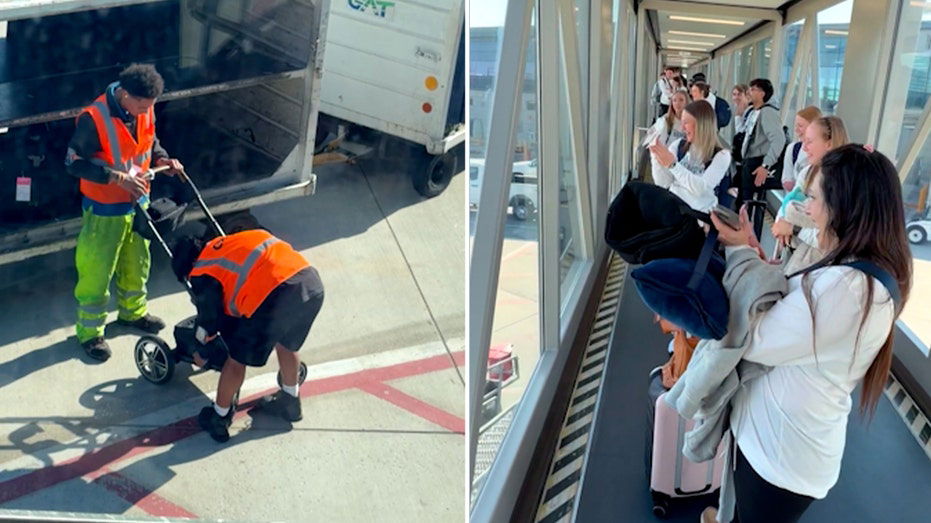
Stubborn stroller sparks chaotic airport showdown with baggage handlers in viral video

- by foxnews
- 01 Apr 2026
Sharks in Bahamas found to have cocaine and other drugs in their systems, study says


travel
- by foxnews
- descember 09, 2016
Birth tourism industry thrives in Miami as Supreme Court showdown gets underway
Birth tourism is a booming concierge industry as Trump's Executive Order 14160 on birthright citizenship faces a Supreme Court challenge in a major case.
read more